
Types of pigment
Organic pigments
Organic pigments are composed of carbon compounds. Before they were synthetically produced they were usually of animal and vegetable origin. Examples of synthetic organic pigments are: alizarin, azo-pigments (the yellow, orange and red colour range), phthalocyanine (blue and green colour range) and quinacridone (a lightfast red-violet pigment).
Inorganic pigments
Inorganic pigments (of mineral origins) are metal compounds, for example oxides. Compared to organic pigments they are few in number. Examples of natural inorganic pigments are umbers, ochres and siennas as these are excavated from the ground. Pigments with the same names are also produced synthetically. Other examples of synthetic inorganic pigments are the cadmium yellow/orange/red, cobalt blue and titanium white.
Lake pigments
Lake pigments are dyes that have been made insoluble for certain liquid binders or thinners. This is done chemically by precipitating the dye on (or fixing the dye in) a colourless substance (inert pigment) that is indissolvable for the particular binding agent. Although the lightfastness of the dye is improved as a consequence, this is only to a small degree. What's more, lake pigments have the bleeding property of dyes: the colour penetrates other paint layers or spreads across the immediate area.
Pigments vs Dyes
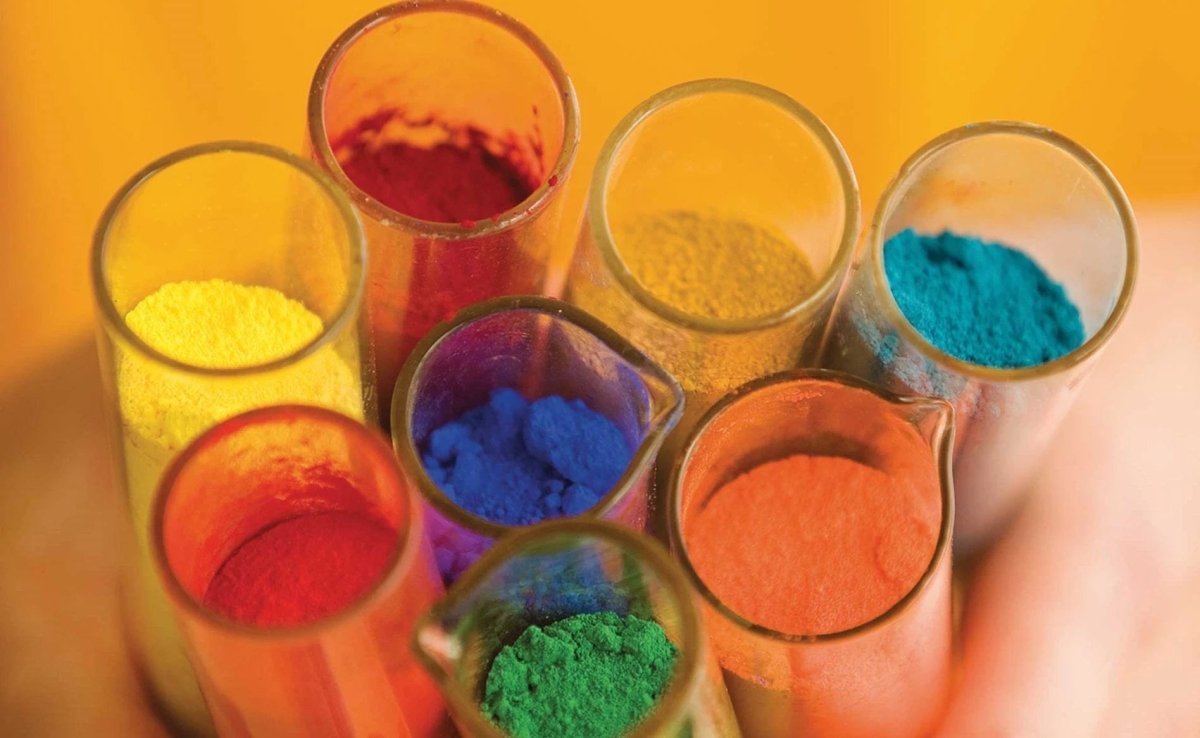
Pigments are coloured powders that do not dissolve in the liquid with which they are mixed. They have to be regularly mixed and ground in the (liquefied) binder. Properties of the paint such as colour, tinting strength, opacity/transparency and lightfastness are determined, among other things, by the type of pigment used.
If a colour-giving substance dissolves in a liquid (disintegrates such as sugar in water) we do not call the colour-giving substance a pigment but a dye.

a. Pigment - insoluble
b. Dye - soluble
Lightfastness and application of dyes
The lightfastness of soluble dyes in paint or ink is poor to moderate. They are therefore not used in products for artists. A painting must be seen, and light is necessary for this; the colours must therefore be durable.
For the illustrator or hobby artist lightfastness is not so important. An illustration is printed, after which the original can be kept in a dark place; children and hobby artists do not have the same requirements as artists when it comes to the durability of colours. Due to their solubility dyes are highly suited for colouring thin liquids with a particular transparency as well as transparent inks.
Soluble dyes bleed; the colour penetrates other paint layers or spreads throughout the immediate area.
Royal Talens uses dyes only in two products: Ecoline (with the exception of white and gold) and waterproof drawing ink (with the exception of white and black). The lightfastness of these products is not indicated on their packaging. Works of art produced with soluble dyes can be best stored sealed. The above exceptions are pigmented, opaque and very lightfast.


