Blue shades - Royal Talens

About our blue shades

Each blue has its own undertone which can lean either towards green or towards red, also called ‘green shaded’ or ‘red shaded’ respectively. This undertone also determines the colour temperature of the shade: shades with red undertones are warm blues, while green undertones create cold blues.

Since the actual colours can be difficult to judge straight from the tube, each shade is mixed with white to showcase its unique properties and undertones. This might help you select the right colours for your next artwork.

Transparency

Many blues in the Rembrandt collection are transparent or semi-transparent, which makes it difficult to judge the actual colour right away. Though the pigments themselves are transparent or semi-transparent, since they are so concentrated, they look much darker and more opaque.

If you spread a thin layer of a transparent shade onto a canvas, you are looking through far fewer of the pigments, so the light can pass through the paint and bounce back on the white canvas to your eye. This allows you to experience the blue shade in its true form.

To preserve these beautiful properties, we recommend mixing these shades with an equally transparent or semi-transparent colour. If you mix these transparent shades with a more opaque shade, both the transparency and brightness of the colour will be diminished. The opaque pigment will overpower the more transparent pigment.

Assortment

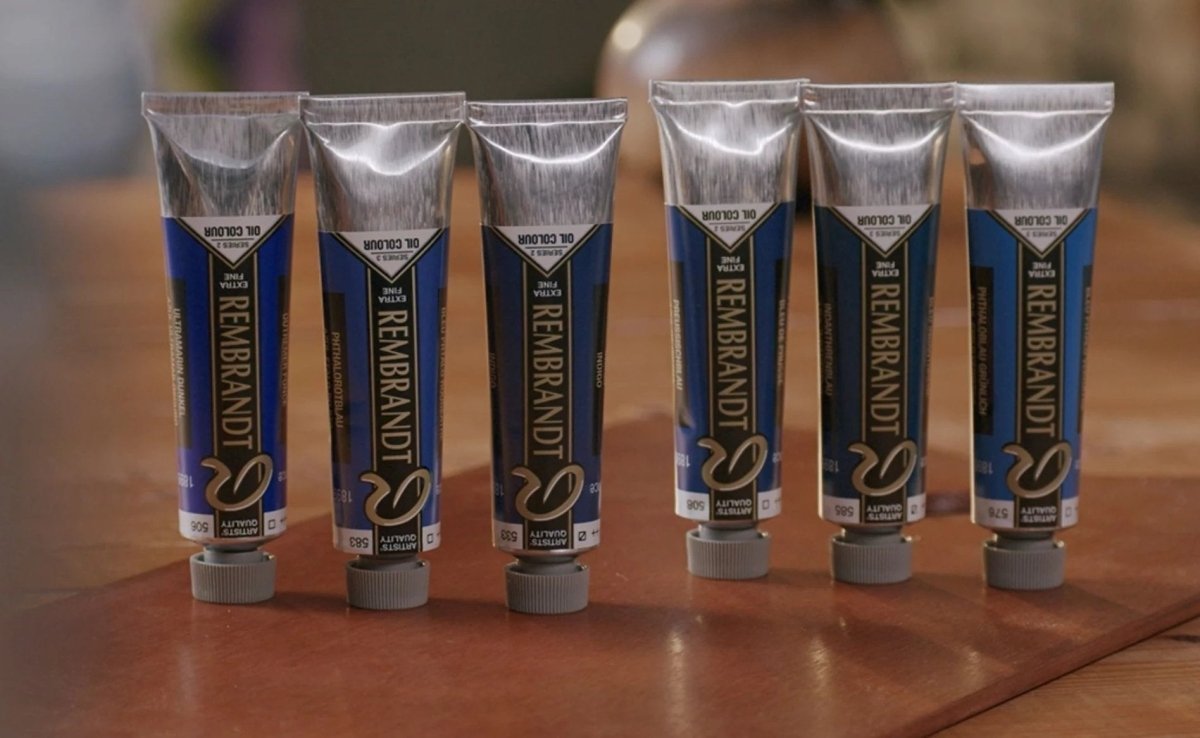
The Rembrandt oil paint collection features various bright blues in transparent and semi-transparent shades. To showcase their undertones while still protecting their unique characteristics, all shades were mixed with 103 Mixed White.

The following shades of blue were used in this video:

  • 506 Ultramarine Deep
  • 508 Prussian Blue
  • 533 Indigo
  • 576 Phthalo Blue Greenish
  • 583 Phthalo Blue Reddish
  • 585 Indanthrene Blue

Rembrandt oil colour - blue shades

Related blogs

The Old Masters’ palette and its relevance today - Royal Talens
Painting with oil paint

The Old Masters’ palette and its relevance today

Seventeenth century painters like Rembrandt, Vermeer and Hals are known for their dramatic light and rich colours. Their carefully chosen...
Exploring limited palettes and glazing techniques with Ale Casanova - Royal Talens
Painting with oil paint

Exploring limited palettes and glazing techniques with Ale Casanova

One of the greatest needs of painters is to keep putting themselves in situations that must be solved, challenges that...
The construction and finishing of an oil painting - Royal Talens
Painting with oil paint

The construction and finishing of an oil painting

Oil paint is the most complicated of all paints from a materials point of view when it comes to the...
Oil paint Colour-mixing - Royal Talens
Painting with oil paint

Oil paint Colour-mixing

Using Van Gogh oil paint in the three primary colours: 267 Azo Yellow Lemon, 366 Quinacridone Rose and 570 Phthalo...
Painting an ear - Royal Talens
Painting with oil paint

Painting an ear

Ears are ignored by so many artists but it's incredibly interesting to paint them! There are so many things going...
Painting a nose - Royal Talens
Painting with oil paint

Painting a nose

"Today we’ll paint a nose. I love noses! And I hope that I could share a piece of my love...
Painting a blue eye - Royal Talens
Painting with oil paint

Painting a blue eye

Inspiration can come from anywhere. For this eye, I was inspired by an incredible paint color - King’s Blue. I...
Landscape painting - Royal Talens
Painting with oil paint

Painting a landscape

In this step-by-step plan, Anouk Bijsterbosch shows us how to create an open-air landscape using Rembrandt oil paint. Also watch...