The Old Masters’ palette and its relevance today

A limited palette as a source of creativity

When we think of the great painters of the 17th century, Rembrandt, Vermeer, Hals, we immediately see their masterful use of light, dramatic compositions and warm, deep colour schemes. But one aspect that often remains underexposed is the palette they worked with. Not only their technique, but precisely the choice and limitation of pigments formed the basis of their visual language. In an age when we have access to practically every colour imaginable, it is surprisingly refreshing to consciously return to this centuries-old palette structure.

The pigments that shaped their paintings

The classical palette of the old masters was small, purposeful and surprisingly versatile. Pigments such as lead white, ochres, bone black, vermilion and various earth tones formed the backbone of their work. What at first glance appears to be a limitation was in fact an enormous strength. A natural harmony emerged that we still recognise today. In doing so, they made use of properties that are now rarely found. Lead white, for example, dried very quickly, allowing painters to work much faster than if they had used titanium white in safflower oil, a modern but considerably slower-drying combination.

The Zorn palette and modern interpretations

Interestingly, later masters also consciously chose a limited palette. The Swedish painter Anders Zorn worked with what is now known as the “Zorn palette”: cadmium red, ochre yellow, ivory black and white. With just four colours, he could create almost any shade. It often reminds me of the palettes I use myself in Rembrandt reconstructions: ochre yellow, mercury vermilion, bone black and lead white. Nowadays, vermilion in a tube is of course no longer toxic mercury vermilion, but a synthetic imitation fortunately just as brilliant, but a lot safer.

Why limitation still works for artists

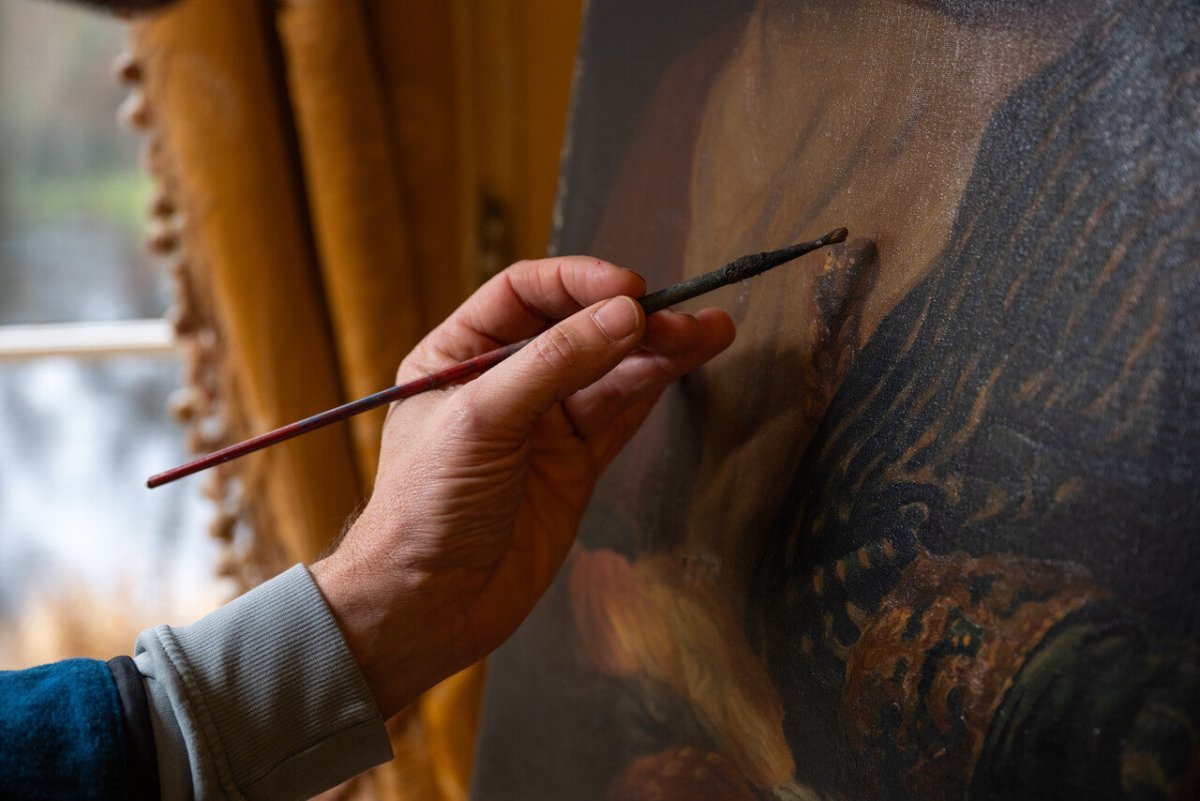
In my work, I regularly opt for this traditional palette structure. Not out of nostalgia, but because limitation forces ingenuity. With a handful of colours, every nuance must be carefully mixed. Soft skin tones, subtle half-shadows and deep warm tones do not come from a ready-made tube, but often from the process of mixing, layer upon layer.

Craft, simplicity and contemporary relevance

And that is precisely what makes the old palette relevant again for modern painters. At a time when many artists are searching for authenticity, sustainability and tranquillity, the simplicity of the 17th-century palette fits in remarkably well. It suits attentive work and the appreciation of craftsmanship over speed. It also provides a clear starting point for those who want to experiment with classical techniques such as glazing, imprimatura and optical mixing.

How constraint brings focus and freedom

What appeals to me most personally is that this limitation is actually liberating. Less choice brings more focus. Once you understand how the colours relate to each other, a kind of tranquillity emerges in the painting process. And if you look closely at self-portraits from the 17th century, you will notice something striking: when painters painted their own palettes, they always seem to have the same composition – white, ochre, red and sienna tones, brown and black in the same order on their wooden palettes. It is as if they all had lessons from the same master. Sometimes a fresh perspective can be found in an old palette.

About the author

This blog was written by Nard Kwast. Nard Kwast (1973) was born and raised in the north of the Netherlands. He lives and works in both the Netherlands and Belgium. His drawing talent developed at an early age and as a teenager he discovered his fascination for the seventeenth century old masters. His decision to take private lessons and immerse himself in classical oil painting techniques stems from a deep passion for these traditional methods and materials.

Over the past decades Nard has developed a distinctive style that clearly references the painters of the seventeenth century. He continues to explore and refine this style and enjoys sharing his knowledge through masterclasses.

Find out more about Nard