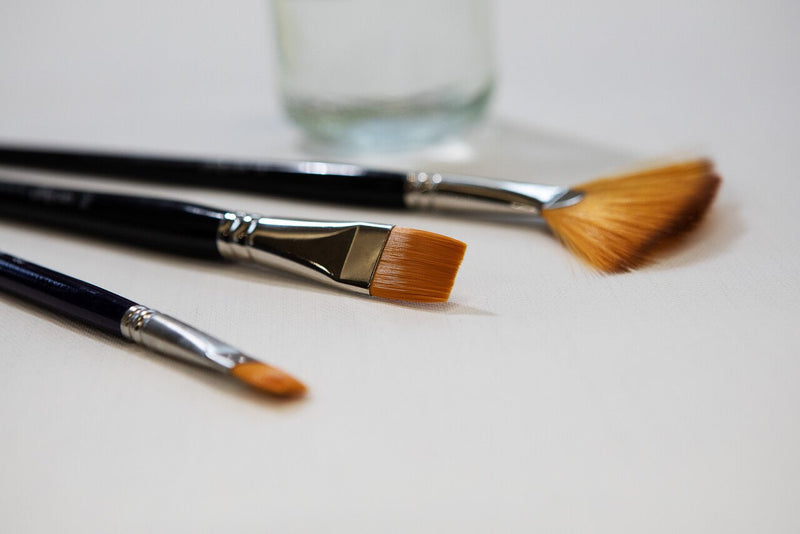
Find the right brush for every technique from well-known brands like Amsterdam and Rembrandt. Our range includes brushes made with natural hair or polyester in different shapes and sizes, designed for various painting styles and techniques.
Clean the brushes immediately under running cold water. Do not rub because pressure causes the rubber particles to stick together. Instead of a brush, use a cotton swab for applying.
Yes, these brushes can definitely still be saved! Dried out acrylic paint has ruined many good brushes, but with Amsterdam acrylic remover, you can clean your brushes long after the paint has dried. This completely biodegradable medium allows dried acrylic paint to dissolve from brushes and other painting tools.
Dried oil paint can only be broken down in very aggressive solvents such as xylene. Due to the harmfulness of these solvents, they are not sold by Royal Talens. The long drying time of oil paint gives the painter enough time to clean the brushes.
The choice of brush depends on the painting technique. Brushes made of hog bristle are the most commonly used for oil paint. The stiffer hog bristle can hold a lot of thick paint, but gives too imprecise a stroke for painting fine details. For detailed work and glazing techniques, sable hair, among others, is very suitable. For all techniques, brushes made of synthetic fibres (selected filament) offer a good alternative. Oil paint brushes have a long handle so that sufficient distance can be kept from the work when painting.
Brushes made of firmer types of hair are the most commonly used for acrylic painting. Polyester brushes, also known as filament brushes, are water resistant and suitable for both thick and very diluted paints, which makes them perfect for acrylic paint.
Hog hair brushes can hold a lot of thick paint, but have a brush stroke that is too inaccurate for working in fine detail. What's more, with water hog hair brushes become a little less resilient.
The softer types of hair can hold a lot of water and are therefore used as watercolour brushes. Depending on the type of hair, there are brushes in a wide range of qualities and price ranges. Brushes made of pony, goat and ox hair and selected filament brushes are very affordable. More expensive brushes made of squirrel, red sable and red Kolinsky hair are of excellent quality.
Almost all hair types are suitable for gouache, but the choice depends on the technique used. If the paint is thinned (strongly) with water, brushes with softer hairs such as ox and (kolinsky) sable hair can be used. In all cases, polyester brushes (selected filament) are an excellent alternative.