Painting an eye - Royal Talens

What you need

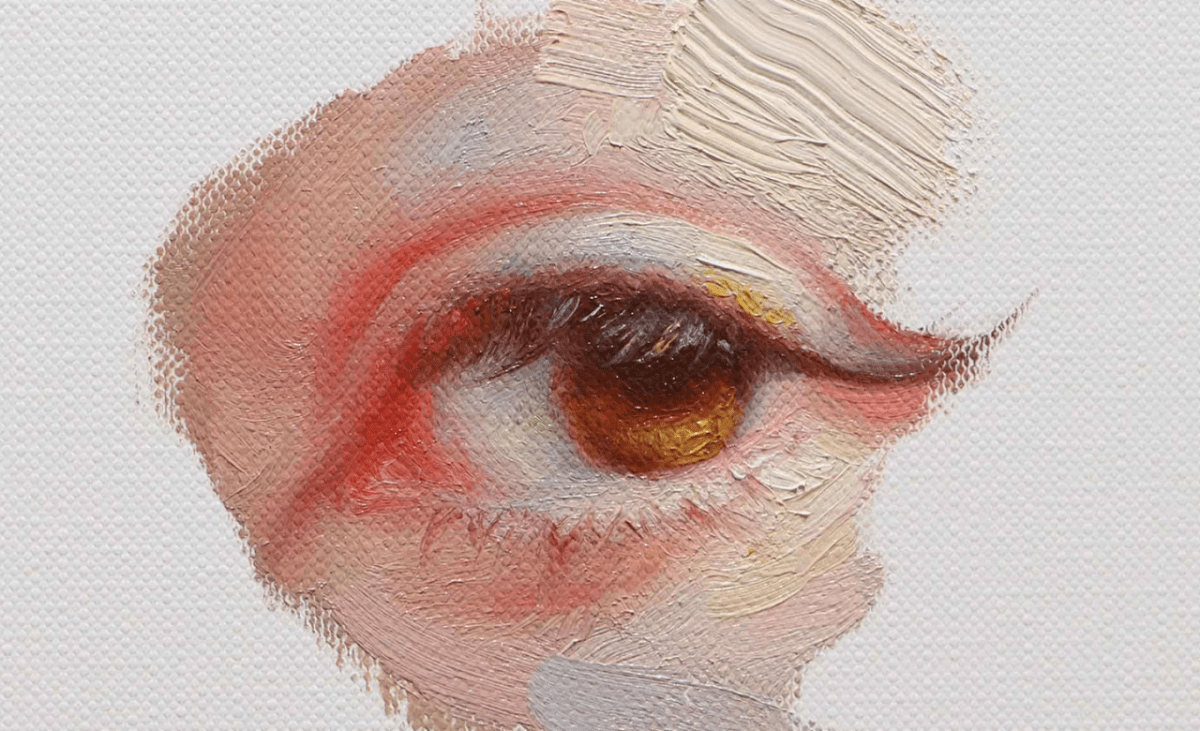
I’ll be using oil paints, but you can also try acrylics or gouache. Your result may vary depending on the saturation of your red and yellow. However, the aim of this lesson is not to create a perfect copy of my painting but to show you how much you can do with only 4 colors.

  • Rembrandt oil Titanium White (118)
  • Rembrandt oil Yellow Ochre Light (228)
  • Rembrandt oil Cadmium Red Light (303)
  • Rembrandt oil Ivory Black (701)
  • Round (#1 and 2) and flat (#7) synthetic brushes
  • Tear-off palette
  • Talens White spirit for cleaning the brushes
  • Talens bleached linseed oil (025) to dilute the paint

Tips

  • Before you start, go through all the steps.
  • If you want to work without solvents and produce a similar end result, you can work with Cobra water-mixable oil paint.
  • You also can try acrylic or gouache for this step-by-step plan
  • If you don’t have Ivory Black (701) – you can take any other black and add some blue to it (any that you have!) and you’ll get needed grey-blue tint.
  • Brands above can also be other brands f.e. Van Gogh.

Before we start

You need to prepare mixes of colours: light, medium and dark.

  1. The darkest one is mix of Ivory black (701) and Cadmium Red Light (303)
  2. The middle –Cadmium Red Light (303) and Yellow Ochre Light (228)
  3. The lightest is the most yellow

Everything else we’ll be mixing out of these colors.

Also, you can prepare 3 different values of Ivory black (701) mixed with Titanium White (118)

The first step is to make an outline.

Step 1

I’m using a brown paint (black + white + yellow + red) and a little bit more diluent than usual.

Start adding your colours.

Step 2

Let’s make it simple and apply light, medium and dark colors.

It’s time to add some details.

Step 3

We can make the left side looking warmer by adding some red and yellow to our basic middle color mixture. The transitional colors between light and medium I create by mixing them together.

Some white + a bit of ivory black will help us to add coolness to the transition between light and medium.

More details!

Step 4 - 7

Let’s repeat the same things that we did before – mix two colors that are next to each other on our palette and add it to our eye.

Let's start the most intriguing part of the process – blending.

Step 8

I take an old fluffy brush (a round synthetic one). It’s a good idea to experiment with the size of the brush. I have a rule – if you can paint it with a bigger brush – use it. The bigger the better.

You need to smooth the lines between two colors. It should be really easy. If you feel that it’s not – mix more transitional colors and add them to the area that you are working on.

The next step is when you can have fun and turn on your creative side. Take a big brush (hard, like a bristle one), or fan brush, or a palette knife – anything that you want to and work on borders of our painting.

Step 9

I’ve added two brushstrokes (that’s how creative I am :) ) on top of the eye.

Eyelashes. Not my cup of tea. Usually, I paint them using a tiny brush lash by lash making them darker at the roots and lighter at ends. This time I wanted to experiment and use a fan brush. It’s definitely much faster but you still need to add details on top with a usual brush. The same thing I did with lower lashes. The only difference is that I was using a much lighter paint.

And we are done! I hope that this tutorial was useful. Keep working and don’t forget to have some fun!

Made for @royaltalens.eu by @zarinasart artist

Related blogs

The Old Masters’ palette and its relevance today - Royal Talens
Painting with oil paint

The Old Masters’ palette and its relevance today

Seventeenth century painters like Rembrandt, Vermeer and Hals are known for their dramatic light and rich colours. Their carefully chosen...
Exploring limited palettes and glazing techniques with Ale Casanova - Royal Talens
Painting with oil paint

Exploring limited palettes and glazing techniques with Ale Casanova

One of the greatest needs of painters is to keep putting themselves in situations that must be solved, challenges that...
The construction and finishing of an oil painting - Royal Talens
Painting with oil paint

The construction and finishing of an oil painting

Oil paint is the most complicated of all paints from a materials point of view when it comes to the...
Oil paint Colour-mixing - Royal Talens
Painting with oil paint

Oil paint Colour-mixing

Using Van Gogh oil paint in the three primary colours: 267 Azo Yellow Lemon, 366 Quinacridone Rose and 570 Phthalo...
Painting an ear - Royal Talens
Painting with oil paint

Painting an ear

Ears are ignored by so many artists but it's incredibly interesting to paint them! There are so many things going...
Painting a nose - Royal Talens
Painting with oil paint

Painting a nose

"Today we’ll paint a nose. I love noses! And I hope that I could share a piece of my love...
Painting a blue eye - Royal Talens
Painting with oil paint

Painting a blue eye

Inspiration can come from anywhere. For this eye, I was inspired by an incredible paint color - King’s Blue. I...
Landscape painting - Royal Talens
Painting with oil paint

Painting a landscape

In this step-by-step plan, Anouk Bijsterbosch shows us how to create an open-air landscape using Rembrandt oil paint. Also watch...