Hilma af Klint, the pioneer who hid her own revolution - Royal Talens

A classically trained artist with radical curiosity

Hilma af Klint (1862–1944) was a Swedish artist with a sharp mind, a gentle presence and a lifelong fascination with both the visible and invisible aspects of nature. Trained as a classical painter, she could depict botanical details with scientific accuracy, yet she wanted more than mastery of the physical world. She wanted to understand how life unfolded on spiritual and energetic levels, a curiosity that led her far beyond academic conventions.

Seeking the invisible

Her artistic evolution accelerated when she joined a small circle of women known as “The Five.” They met regularly to meditate, practise automatic drawing and explore the idea that creative images might come from deeper levels of consciousness. In her notebooks, Hilma wrote that certain paintings appeared “with great force, painted directly through me,” as if she were receiving ideas rather than inventing them. This intuitive method opened the door to a new visual language.

The Paintings for the Temple

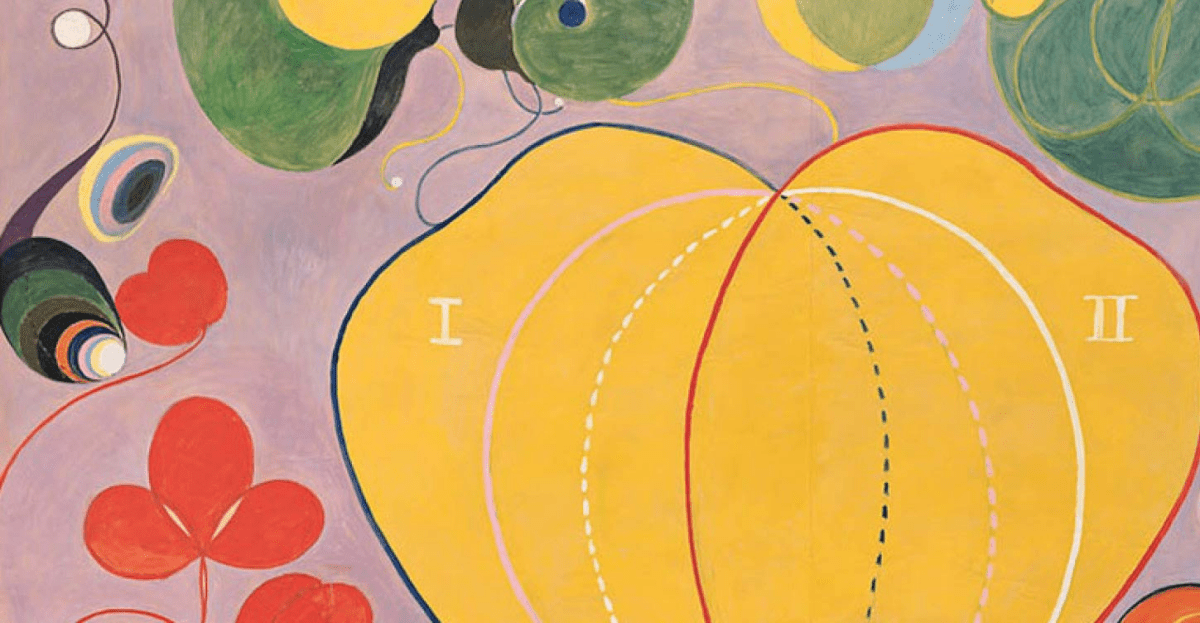
Between 1906 and 1915, she produced her most ambitious cycle, the “Paintings for the Temple.” These works are vast, colourful, symbolic and entirely non-representational. Spirals, diagrams, botanical motifs and geometric structures swirl together into a visual cosmology unlike anything else in Western art at the time. These canvases, some over three metres tall, predate Kandinsky’s abstractions by several years and were conceived as part of a complete philosophical system.

Hilma even imagined a specific place for them. She envisioned a round or spiral-shaped building called the “Temple,” in which visitors would ascend slowly through the space while the paintings guided them on an inner journey. Art, for her, was not decoration but a form of spiritual architecture.

Recognition that came too early

Around this time she met Rudolf Steiner, the Austrian philosopher and founder of Anthroposophy and the Waldorf school movement. Hilma admired him deeply and hoped he would recognise the significance of her work. Steiner did find her ideas intriguing, but he also told her that “humanity is not yet ready” for her abstract visions. It was not the encouragement she hoped for. She began to withdraw further, later requesting that her works not be shown until at least twenty years after her death.

A small anecdote captures the tone of their encounter. When she allowed Steiner to borrow several paintings, he forgot them in his office for months. Hilma eventually sent a polite note asking for them back. It is a quiet reminder of how invisible her groundbreaking achievements were in her lifetime.

A legacy discovered too late

After her death, more than 1,200 paintings and tens of thousands of pages of notes were stored in her nephew’s attic, where they remained for decades. When they finally resurfaced, the world realised how far ahead she had been. Many works, created on paper sheets glued together and mounted on larger supports, now show their fragility, a gentle lesson that materials matter, especially when the future may look back more closely than you ever imagined.

About the author

Justyna Pennards is an artist whose practice is rooted in the belief that growth is possible anywhere and at any stage of life. Drawing inspiration from nature and botanical gardens, her work explores the relationship between living systems and the built environment. Alongside her artistic practice, she works as a Technical Advisor in R&D at Royal Talens, combining artistic research with material and technical expertise to inspire sustainable growth, reflection, and creativity.