Colour mixing chart - Royal Talens

What you need

In this example, we are using Bruynzeel fineliner/brush pens, but you can use the same technique with any other colours.

  • Bruynzeel Fineliner/Brush pens set of 12 colours
  • Bruynzeel HB pencil and eraser
  • Tear-off palette or plastic sleeve containing a white A4 sheet
  • Good sturdy paper, e.g. Van Gogh watercolour paper 300 grams
  • Watercolour brush
  • Paper towels
  • Cups of water for mixing and to clean the watercolour brush during and after use

Tips

  • Read through all the steps before you start.
  • Leave the paper to dry thoroughly before applying the next layer.
  • Make sure to clean your brush between uses and once you're finished.

Step 1

Start with the squares.

Copy the example on the water colour paper. Draw squares on good sturdy paper. Thirteen squares vertically and twelve squares horizontally. Colour the squares furthest to the left vertically with the various colours. Do this with the side of the brush.

Step 2

Add your colours.

We are now going to apply each brush pen colour to the tear-off palette or sleeve and mix with water. We do this using the water colour paintbrush.

On a separate sheet of paper, make similar squares to those on the palette or sleeve for each colour. Then add water using the water colour paintbrush.

Step 3

Blend, blend, blend!

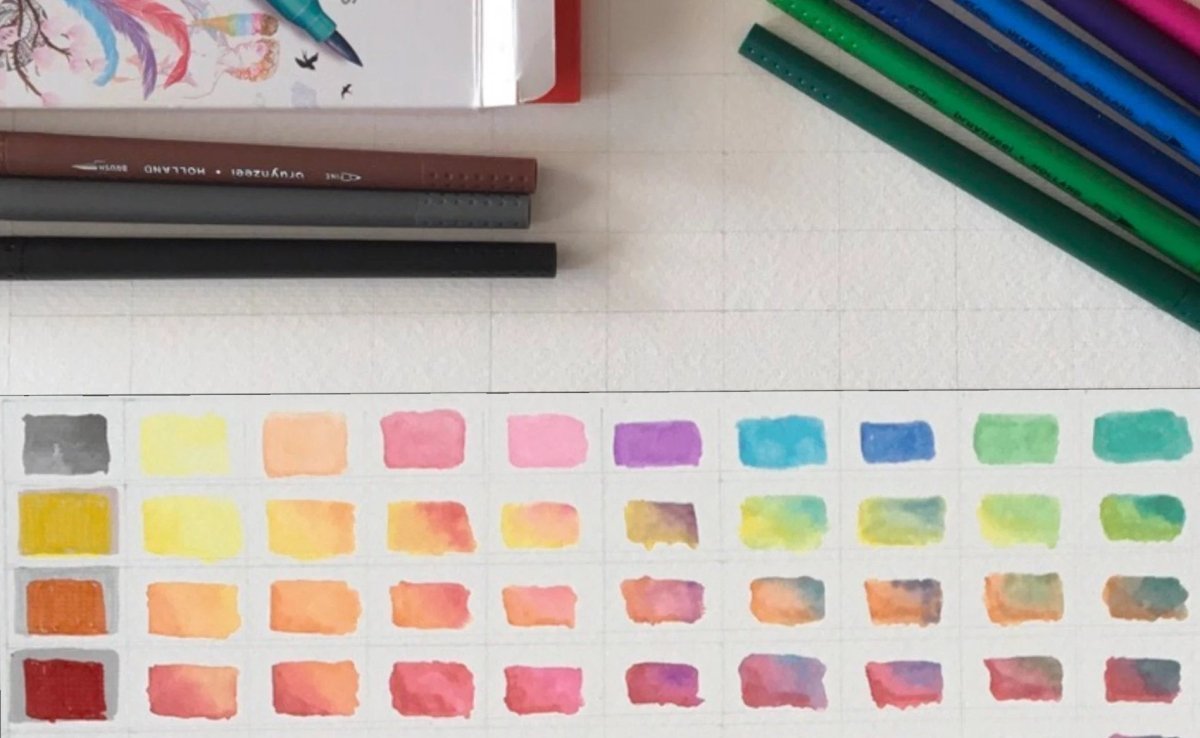
Paint stripes with the brush on the tear-off palette/sleeve, as shown in the photo. Try to make some nice blends using the water colour paintbrush. You can use the kitchen paper to dry your palette.

Step 4

Start mixing your colours and build your chart.

If you look at the first mixture, the colour yellow is applied at the bottom left. The colour yellow mixed with water is applied at the top right. You keep repeating this. So, after this apply the colour orange at the bottom left and yellow mixed with water at the top right. Dab your palette dry with kitchen paper every now and then.

Step 5

Fill your chart and see the results!

To the left, all the colours are shown vertically and at the top of the first row are all of those colours mixed with water. If you keep repeating these steps, you'll end up with this result. You now have a clear mixing chart.

The various possibilities are obvious at a glance. Have fun mixing!

Related blogs

Ocean Colours - Royal Talens
Empower your creativity

Ocean Colours

The ocean has always been a source of wonder. Its colours shift with the light, its depths hold entire worlds,...
Back 2 School - Royal Talens
Empower your creativity

Back 2 School

Every new beginning starts with a blank page. Fresh notebooks, sharp pencils, and space for new ideas to take shape....
Visual Rhythm - Royal Talens
Empower your creativity

Visual Rhythm

Rhythm isn't just something you hear. It's something you paint. This month, we're exploring visual rhythm: the pulse behind fluid...
How Jazz Shaped the Visual Arts - Royal Talens
Empower your creativity

How Jazz Shaped the Visual Arts

You do not need to hear music to feel it. Sometimes you see it. In the restless grid of Mondriaan's...
Rhythm is not just seen, it is felt - Royal Talens
Empower your creativity

Rhythm is not just seen, it is felt

You know rhythm from music. But is it also present in paint, in brushstrokes, in the way your eye travels...
Sketch Your World - Royal Talens
Empower your creativity

Sketch Your World

This month focus on everyday inspiration and step outside to notice the details around you. A familiar street, a fleeting...
Women in Art: Daphne van Mansom - Royal Talens
Empower your creativity

Women in Art: Daphne van Mansom

As Research & Development Director and a member of the management team at Royal Talens, Daphne van Mansom is truly...
Women in Art: Miriam Hommes - Royal Talens
Empower your creativity

Women in Art: Miriam Hommes

Miriam Hommes is a visual artist based in Amsterdam. In the late 1980s, she graduated from the Gerrit Rietveld Academy...