
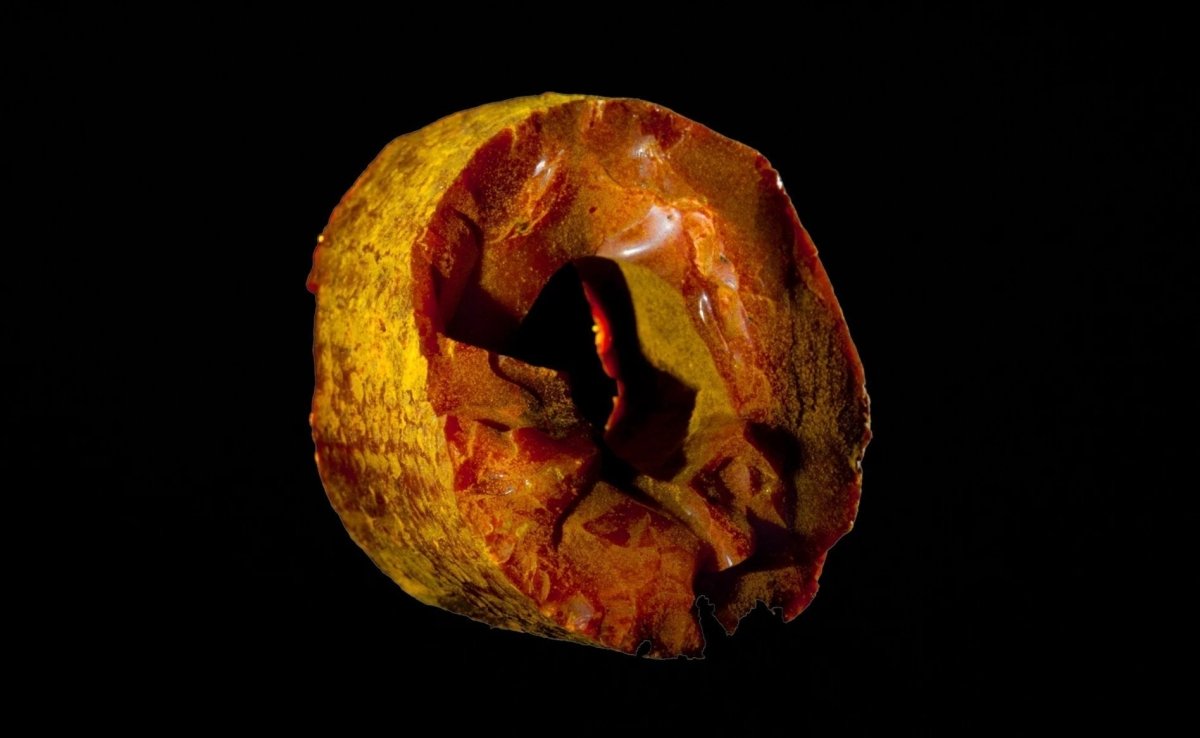
Gamboge: golden yellow poisonous sap
The name Gamboge is derived from the Garcinia tree, which is indigenous to South-East Asia. This therefore also includes Cambodia from which the English name Gamboge comes. The production process is as follows. When the trees are ten years old and some fifteen metres high, the yellow milky sap is tapped from the wood in one of two ways. One way is to make an incision in the bark, the other way is to break off the branches. The sap that comes out is collected in hollow bamboo canes, after which it begins to congeal. In order to extract as much moisture as possible, the canes are then rotated over a fire. What remains are the so-called ‘Gamboge rods’, a brown resinous substance of a pure quality.
Inducing the colour
This naturally extracted Gamboge consists of one-quarter water-soluble gum and three-quarters insoluble resin. It is the resin that gives it its colour. The yellow, however, is hardly visible in a lump of Gamboge. The colour only truly comes to life after the lump, as a water colour pan, is touched with a wet brush and the gum dissolves in the water. It is then that the cohesion of the gum and resin is disrupted and microscopic resin particles end up in the solution, which produces the characteristic warm yellow colour. The solution is now ready to use for painting. This method was already used in medieval writings to colour in ornamental letters and illustrations in texts.
Harmless pigment
Despite the beautiful golden, transparent colour the naturally acquired Gamboge is no longer used. The sap of the Garcinia trees is extremely poisonous and, moreover, has a poor lightfastness, resulting in the colour quickly fading under the influence of light. In the Rembrandt water colour range the colour is made based on harmless pigments with an exceptional lightfastness, so that the Gamboge remains unchanged for at least 100 years under museum conditions.
Medicinal effect…
In addition to the beautiful yellow, the sap of Garcinia trees contains ingredients that are said to be beneficial for rheumatism and intestinal complaints. Furthermore, it is used in slimming remedies, albeit in small doses as 4 gram pure sap would already be lethal.


