
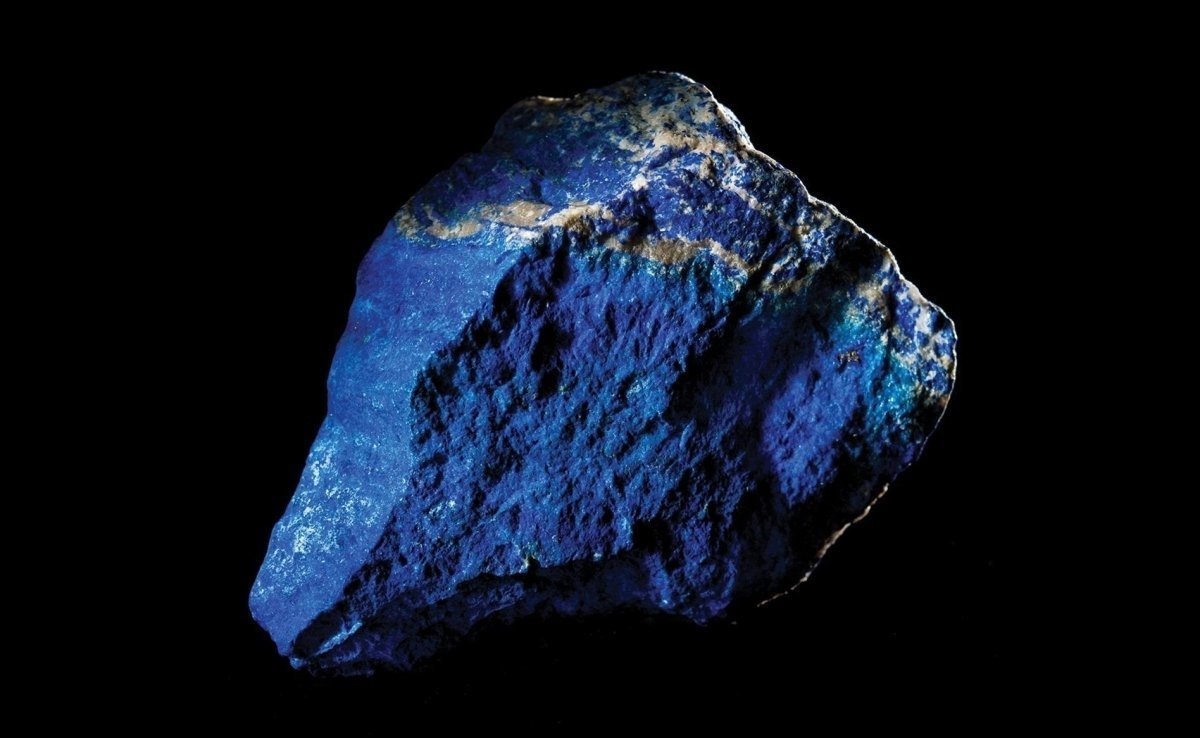
Ultramarine: the blue gold
Originally Ultramarine was obtained from the semi-precious stone Lapis Lazuli, literally ‘stone’ (Latin) and ‘blue’ (Persian). An extraordinarily laborious and expensive process, whereby the stones are ground by hand and all the impurities are removed. The best quality Lapis Lazuli was traditionally mined in Afghanistan, where Ultramarine was already being used in, for example, murals in the 6th and 7th centuries.
Expensive pigment
In the beginning of the thirteenth century a method was developed that allowed an even purer pigment to be obtained from the stone. This resulted in a considerable decrease in profit per stone, and an unprecedented increase in price which even exceeded that of pure gold. Nevertheless, artists were so impressed with the colour intensity and lightfastness that the demand only increased. Also in Western Europe, which since the 14th century received ever larger quantities of Lapis Lazuli shipped from overseas. And this in fact is how Ultramarine derived its name, ‘ultra marum’, Latin for ‘beyond the sea’. Due to the high price, however, the pigment was by no means part of artists’ standard range of colours. What’s more, we know that artists such as the Dutch 17th century masters charged their clients for the extra cost of Ultramarine.
Properties
Ultramarine is a blue pigment with ‘traces of red’. Mixed with bluish reds it offers numerous possibilities for creating surprising shades of violet. In addition, Ultramarine is often used as a transparent layer in the glazing technique. If applied thinly on a white ground or by mixing it with a little white paint, the characteristic, intense, clear blue colour is created.


