Painting the Sound of Colour with Amsterdam Acrylics - Royal Talens

Rhythm has always been part of art

Long before acrylics, artists were translating movement and music into visual form. Repeating lines, shifting colours, and layered marks gave paintings a quality that felt less like a still image and more like something unfolding in time.

Water-based media have always suited this kind of work. Ink captures speed and gesture. Watercolour creates soft, layered transitions. Gouache builds rhythm through flat shapes and bold contrast. Acrylic brings all of these qualities together in one medium.

Why acrylics work for visual rhythm

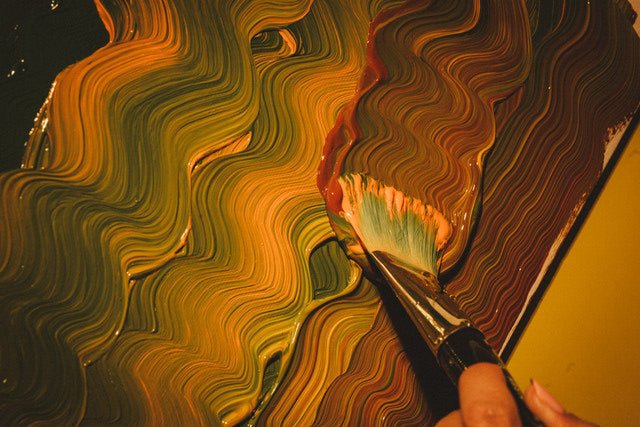
Acrylics dry quickly. That means you can layer, repeat, and build without long waits between stages. Thin washes move like watercolour. Thicker passages pulse with the energy of a brushstroke or palette knife. Poured colour flows and settles in ways that feel almost musical.

Amsterdam Acrylics are especially well suited to this way of working. A few approaches worth trying:

  • Thin with water for transparent, watercolour-like washes
  • Add Amsterdam Pouring Medium for flowing, wave-like movement
  • Use Amsterdam Acrylic Markers over dry layers for graphic, music-inspired marks
  • Layer Amsterdam Standard Series with the Amsterdam Pastel Set for soft, retro-inspired colour harmonies
  • Work in the Amsterdam Sketchbook to capture quick visual ideas inspired by a favourite song or memory

Artists who hear music in colour

Wassily Kandinsky believed a painting could work like a symphony. Different shapes and colours functioned like instruments, building towards something you could almost hear. His abstract compositions repeat, shift, and pulse in ways that feel audible.

Contemporary artists continue this conversation, often reaching for acrylics because of their speed, flexibility, and vivid colour. Beatriz Milhazes is a good example: her work combines repeated motifs and rhythmic pattern with brilliant colour, drawing on Brazilian music and dance.

Wassily Kandinsky, Composition 8

Rhythm does not have to be loud

Visual rhythm is not always energetic or bold. Repetition can be quiet and meditative. Think of a series of transparent washes building slowly across a surface, or a single repeated line that shifts almost imperceptibly in colour or weight. These quieter approaches have their own momentum.

Acrylic is well suited to this. Thin it down and it moves like watercolour, soft and unhurried. Work wet into wet and colours bleed into one another in ways that feel organic rather than controlled. Even the pace of the work changes. Sometimes the most powerful paintings whisper rather than shout.

From ink to acrylic

From ancient ink to modern acrylic, water-based materials have always carried the possibility of movement. They flow, gather, repeat, and transform. In the process, they remind us that painting is not only something we see. Sometimes it is also something we feel, hear, and remember. This month, put on your favourite music, open a notebook, and let colour find its rhythm.

About the author

Jeff Olson is a Seattle based artist with more than thirty years of studio practice and exhibition experience. He is both a painter and an educator with a deep understanding of the materials that shape visual expression.

He is the Art Education Director for Royal Talens North America, where he shares his knowledge with universities, art organisations and professional events throughout the United States and Canada. His work focuses on the history, composition and expressive potential of artists materials. Find out more about Jeff on his website.