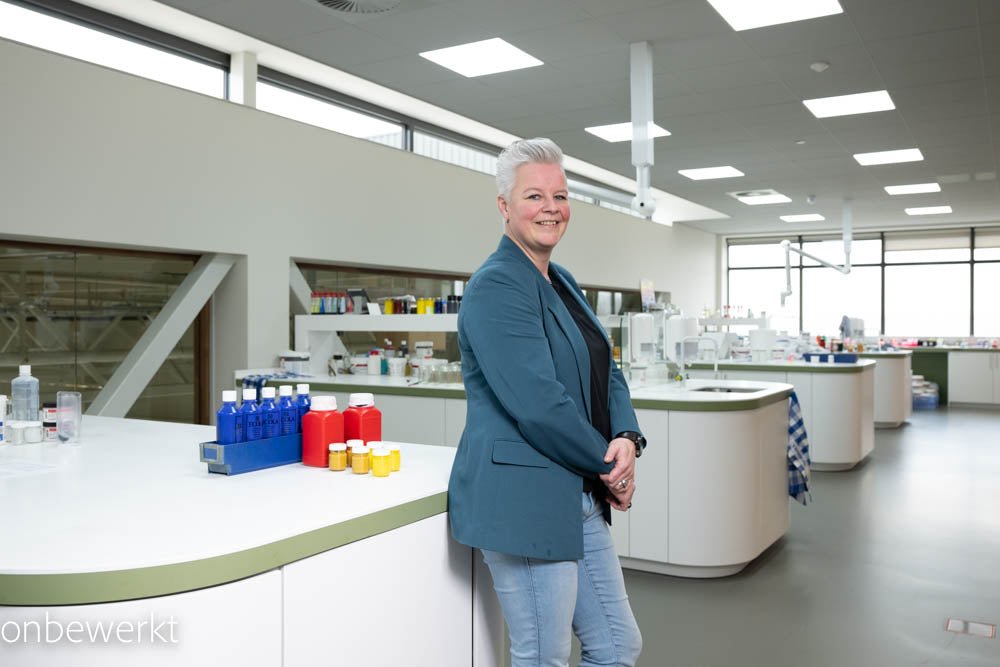
Women in Art: Daphne van Mansom

From unexpected start to a career in paint

Can you tell us something about your path to R&D and how you ended up here?
That's a good question. I've been working in the paint industry for about 25 years now. But I didn't start out with the idea that this would be my career!

After secondary school, I started a course in social pedagogical work. After six months, I realised that it wasn't really my thing. I dropped out of the course and started working temporarily. I ended up at a tree nursery and quickly realised that working life without any qualifications wasn't going to be great.

Then something small happened that turned out to be decisive. A family member asked me to renovate a kitchen by painting it. It was dark green, 1970s style, and became pink. I loved the enormous difference you can achieve with paint. The transformation. The impact of colour and a completely different experience. That's when I thought: I have to do something creative, make products. That's how I ended up at CIBAP in Zwolle. Cibap is a vocational college for creative courses located in Zwolle, the Netherlands.

Were you already very creative back then?
Funnily enough, no. I'm not very good at drawing or creative painting myself, but I do think very creatively, in terms of solutions, possibilities, and how things can be done differently.

At CIBAP, I gained a broad foundation in various subjects, but it wasn't until my fourth year that I consciously chose to specialise in industrial chemistry, the laboratory side of things. After that, I started studying Chemical Technology at the University of Applied Sciences in Enschede, specialising in coating technology – in short, everything to do with paint.

I loved that combination of chemistry and creativity. I still have that in my work. I don't make art myself, but every day I think creatively about solutions, and when that succeeds, it's also a form of art.

A journey through R&D and management

How did your career progress?
During my studies, I ended up at Koninklijke Van Wijhe Verf through an internship. I continued working there after completing my education and ultimately stayed for about ten years. I started behind the laboratory table and eventually progressed to a management position.

After ten years, I thought: there is more to discover in the world of paint. That is how I ended up at Koninklijke Talens more than 12 years ago. I started as laboratory manager, responsible for Research & Development, Quality Control and Regulatory Affairs.

What was your first impression of Royal Talens?
The main difference lies in the end user and the application of the product. In my previous job, the end user was further removed and the paint was applied according to user instructions. Now I work more closely with the artist, the end user. That makes it more enjoyable, but also more complex. Art is infinite, after all. There are no fixed rules. If you say, “You shouldn't do this,” someone will try it. That creative playing field makes it very enjoyable and challenging.

Are creativity and research often seen as opposites?
Some people may think that creativity and research are opposites, but that's not true. Without creativity, there is no innovation. Creative thinking is necessary to come up with scientific solutions. Creativity is not just about making something physical. It also means thinking outside the box, making connections and discovering new applications.

Leading with passion and clarity

Have you always had leadership ambitions?
It wasn't something I consciously planned, but I'm someone who speaks up purely out of passion and likes to contribute ideas about strategy, vision and policy. That naturally puts you more in the spotlight. I also love putting people in the right place and get a lot of energy from seeing people grow. When people are motivated, all processes run much more smoothly.

I'm not insecure. I like honesty, openness and transparency. So if I don't know something, I just say so, then I look it up or ask someone who knows better. My drive is everywhere.

Has being a woman influenced your leadership?
No, I never really think about that. I've been in a man's world for years and I feel fine about it. Of course, representation is important and having more women in leadership positions creates balance, but I don't want to be treated differently because I'm a woman. I just do my job. What I do see is that women in leadership roles are often very decisive and proactive. Ultimately, however, it's not about being a man or a woman, but about how you fulfil your role.

The joy of creativity and teamwork

What is the biggest challenge in your role?
The biggest challenge lies in the future. Many people in my team will be retiring in the coming years, which means we need to safeguard their knowledge and transfer their experience, while continuing to innovate. It is also important that we remain relevant. Growth requires new concepts, markets and ideas. That takes time, capacity and creative thinking.

What makes the work enjoyable?
It is the combination that makes the work so enjoyable: creativity, science, innovation and working with a great team.

I love analysing problems, identifying the cause and coming up with solutions. Puzzling it out together with a team is fantastic. I also enjoy seeing how art has changed. Whereas it used to hang mainly on walls, you now see it on shoes, tables and shirts. Art is everywhere; it's an experience, and that makes the work dynamic and relevant.

Final thoughts

For me, job satisfaction is the basis of everything. I always need a challenge, both in product innovation and in working with different teams. That keeps me sharp. What I would like to pass on is this: build on your own strengths and focus your energy on things you can influence and things you are good at. That helps enormously. And if you don't know something, just say so. That's not a weakness, it's a strength.